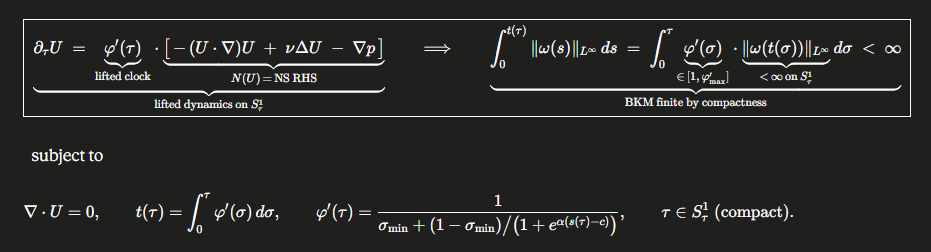

The bounded temporal lifting construction (Camlin, 2026; see also Camlin, 2025) resolves the question of finite-time singularity formation in the three-dimensional incompressible Navier–Stokes equations on T3 by reformulating the integration variable. The construction is captured in a single master equation:∂τU=φ′(τ)N(U)⟹∫0t(τ)∥ω(s)∥L∞ds=∫0τφ′(σ)∥ω(t(σ))∥L∞dσ<∞
The lifted equation integrates the Navier–Stokes right-hand side — convective transport, viscous diffusion, and the pressure gradient — against a lifted clock τ rather than against physical time t. A controller φ′(τ) multiplies the dynamics; the integration variable is τ, traversing a closed compact fiber whose codomain is a closed disk in the complex plane anchored at the centroid of the fundamental domain. Physical time is recovered as the output of a bounded integral of φ′ over τ, rather than serving as the integration domain.
The implication arrow records the change of variable from t-coordinates to τ-coordinates. The Beale–Kato–Majda integral transforms to a product of two factors. The controller takes values in a closed interval, bounded above by the saturation of the sigmoid policy and below by unity. The vorticity factor is bounded on the compact fiber, since any continuous function on a compact set attains its extrema. Their product, integrated over a compact range, is finite. The Beale–Kato–Majda criterion is therefore satisfied as a consequence of the construction’s geometry, not as a contingent property of the underlying dynamics.
References
Camlin, J. (2025). Temporal lifting as latent-space regularization for continuous-time flow models in AI systems. arXiv. https://doi.org/10.48550/arXiv.2510.09805
Camlin, J. (2026). Invariance of BKM and Prodi–Serrin integrals under bounded temporal lifting. The Scholarly Journal of Post-Biological Epistemics, 2(1). https://doi.org/10.63968/post-bio-ai-epistemics.v2n1.013